




WHAT
HOW
RESULTS
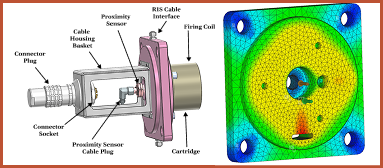
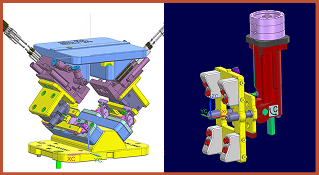
• Redesigned the DL-6T tube-set architecture to improve mass, serviceability, and modularity while keeping the solution cost-feasible for end-users.
• Introduced a modular cartridge concept to isolate electronics + sensing from structural hardware, enabling faster replacement and upgrades.
• Reworked the support and base interface to support multiple elevation configurations and scalable future variants.
• System-level design: defined clear module boundaries (structure vs. electronics vs. tube assembly) and redesigned interfaces for easier assembly and access.
• Mechatronics integration: introduced non-contact detection and a single consolidated connector interface to improve maintainability and field serviceability.
• Engineering decisions: selected materials and manufacturing routes suited for naval constraints
• Validation: used CAD (Siemens NX) and FEA (ANSYS) to verify structural performance, supported by SLS 3D printed prototype to validate fit and assembly logic.
• 32% mass reduction of the tube-set
• Higher maintainability:
cartridge approach reduces invasive disassembly and shortens servicing workflows.
• Improved configuration flexibity:
enabled additional elevation options within the same launcher family.
• Quantified life-cycle impact: estimated long-term savings potential through reduced maintenance effort.

WHAT
HOW
RESULTS
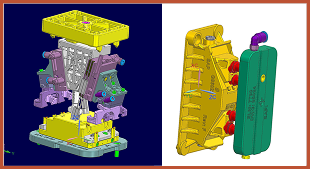
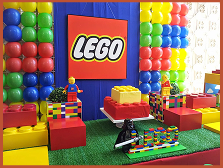
• Designed and delivered 10 custom flex-equipment solutions for LEGO brick decoration, covering the full path from concept to factory implementation.
• Converted designer-driven novelty concepts into manufacturable equipment, ensuring repeatability, precision, and production robustness.
• Supported global deployment of equipment across LEGO production sites.
• Mechanical Design:
designed jigs, removers, alignment tools, and mould grippers in Siemens NX, developing parts for both machining and additive manufacturing.
• Cross-Domain Collaboration: worked closely with designers, injection molding engineers, and manufacturing teams to align functional, aesthetic, and production requirements.
• System Ownership & Integration: independently coordinated equipment design, part ordering, logistics, shipping, and on-site support.
• Innovation & Testing:
developed and evaluated new equipment concepts aimed at improving production efficiency, validating solutions through testing and iteration.
• 10 equipment projects delivered end-to-end, from design to production use.
• Successful implementation in LEGO factories in Mexico, Vietnam, and Hungary.
• Strong hands-on experience in industrial equipment design, manufacturability, and real-world implementation in a global production environment.

WHAT
HOW
RESULTS
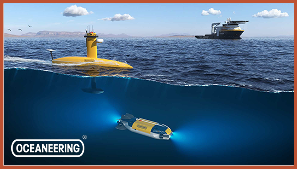
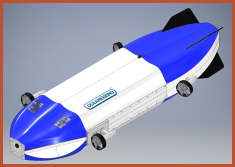
• Redesigned the power system of Oceaneering’s Freedom UUV by replacing lithium-ion batteries with a hydrogen-based solution.
• Evaluated technical feasibility of hydrogen integration for real-world subsea operations under harsh environmental conditions.
• Assessed sustainability and operational impact, focusing on mission endurance, system mass, and lifecycle emissions.
• System modelling & architecture: developed a full UUV power system architecture including fuel cells, hydrogen and oxygen storage, propulsion interface, and thermal considerations.
• Simulation & validation:
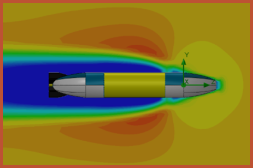
built a 3D CAD model for internal space management and ran fluid simulations to determine drag and propulsion power requirements.
• Trade-off Analysis:
compared system performance across mission durations to quantify scalability and long-mission advantages.
• ESG & lifecycle assessment: performed a comparative LCA covering raw materials, manufacturing, operation, and end-of-life impact.
• >60% reduction in power-system mass, enabling significantly longer missions within the same vehicle volume.
• Clear sustainability gains: reduced lifecycle emissions and elimination of critical battery-material dependencies.
• Demonstrated feasibility of near zero-emission UUV operations for future offshore inspection missions.

WHAT
HOW
RESULTS
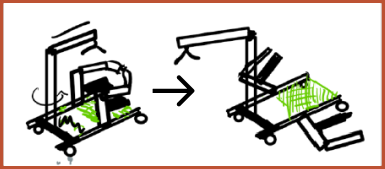
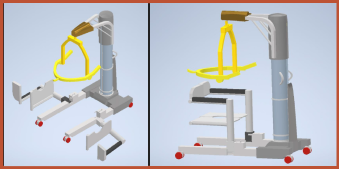
• Developed VertRaise 2.0, a mobile lifting device designed to safely transport patients with mobility issues.
• The project aimed to improve patient comfort and reduce caregiver strain during lifts, enhancing safety and efficiency.
• Designed the device in Inventor, incorporating GD&T, along with a battery-powered mast and remote control.
• Conducted structural calculations to ensure stability during lifts, using worm gears, actuators, and counterweights.
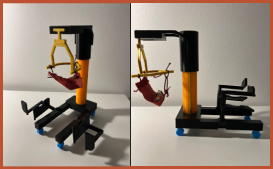
• Built a functional mock-up using 3D printing and laser cutting, refining the design for practical testing and validation.
• Produced a reliable lifting device that minimizes caregiver involvement while ensuring patient safety and comfort.
• Showcased skills in mechanical design, GD&T, 3D printing, and prototype development.
• Successfully addressed both patient and caregiver needs, delivering a practical and efficient solution for healthcare facilities.
WHAT
HOW
RESULTS
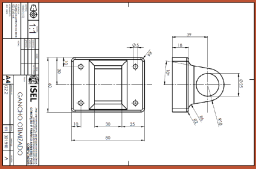
• Designed, optimized, and manufactured a hook as part of a practical engineering project.
• Focused on applying CAD/CAE/CAM technologies to enhance design efficiency and streamline the manufacturing process.
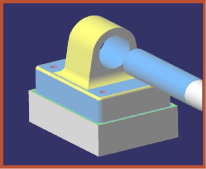
• Performed static analysis and optimized the hook using SolidWorks, reducing the mass by 25%, while maintaining a safety factor above 1.5.
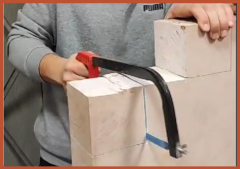
• Generated NC code in CATIA V5 and programmed a CNC machine to manufacture the hook.
• Created a functional prototype using PLA filament
• Achieved a 25% mass reduction and enhanced the design for efficient material use.
• Demonstrated proficiency in SolidWorks, CATIA V5 and CNC machining.
• Gained hands-on experience in troubleshooting production issues and adapting to real-world technical challenges.
WHAT
HOW
RESULTS
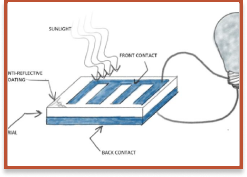
• Conducted a feasibility study to determine the viability of using solar energy for thermal heating and electricity generation at Ejby Maskinfabrik.
• Utilized MS Project for detailed project scheduling, ensuring efficient exploration of photovoltaic (PV) panels and thermal collectors to reduce energy costs and improve the company's environmental footprint.
• Investigated and selected the most efficient and cost-effective solar panels and thermal collectors.
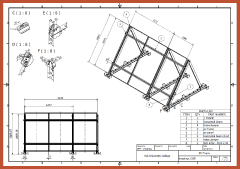
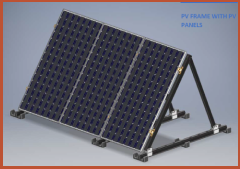
• Designed a solar system to meet the company’s energy demands, optimizing both fixed and tracking mounts.
• Modeled the system in Inventor Professional and conducted a detailed financial analysis to assess return on investment.
• Identified the optimal solution as a PV and thermal collector mix, capable of generating over 51,000 kWh annually, covering energy needs while maximizing cost savings.
• Demonstrated proficiency in solar energy system design, financial modeling, and technical testing, concluding that the project would offer long-term financial and environmental benefits for the company

WHAT
HOW
RESULTS
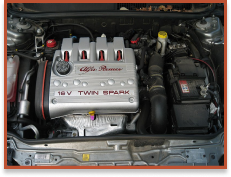
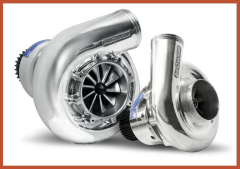
• Designed and analyzed a hydrogen-powered reciprocating engine with a focus on supercharging to enhance performance and efficiency.
• The aim was to modify an existing petrol engine to run on hydrogen, improving power output and fuel efficiency while reducing emissions.
• Applied supercharging calculations to optimize air-fuel ratio (AFR) for hydrogen combustion, balancing power and NOx emissions.
• Analyzed the thermal and mechanical behavior of the engine under increased mean effective pressure (MEP) due to supercharging.
Modeled and simulated engine modifications, such as upgrading fuel injectors and adding an intercooler to manage higher intake temperatures.
• Achieved up to 15% more power and improved fuel efficiency.
• Highlighted key technical challenges, including durability and cost, making the conversion impractical for the older engine model.